
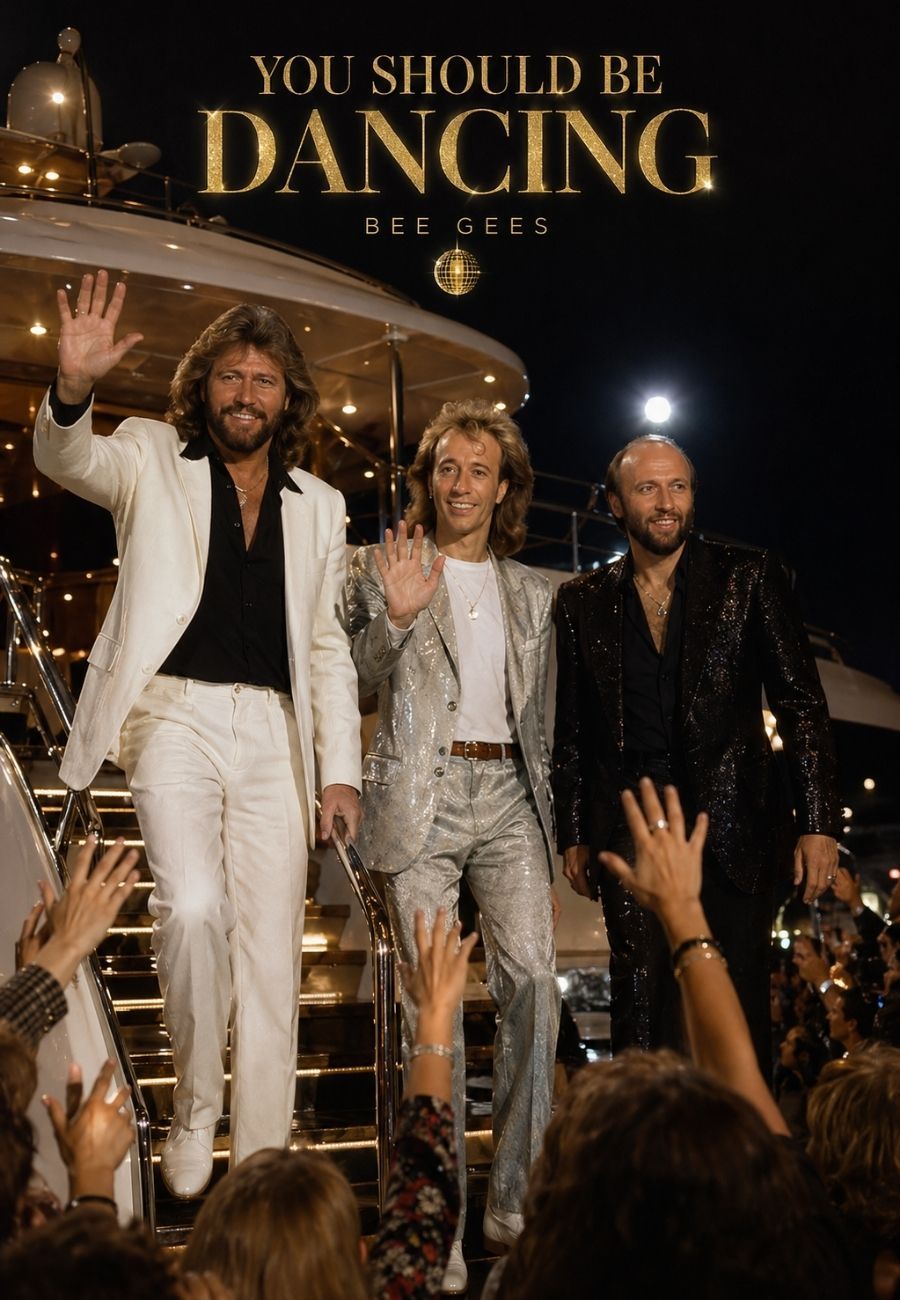
WHEN RHYTHM BECAME AN INVITATION — THE ELECTRIC ENERGY AND ENDURING SPIRIT OF “YOU SHOULD BE DANCING”
There are songs that simply entertain, and then there are songs that transform the atmosphere of an entire room the moment their rhythm begins. “You Should Be Dancing” by the Bee Gees belongs unmistakably to the latter. From its first pulse of percussion to the soaring vocal lines that follow, the recording stands as a celebration of movement, vitality, and the irresistible power of music to unite people in shared joy. Decades after its release, the track still carries an unmistakable spark—one that reminds listeners of a time when dance floors glowed with energy and melody guided every step.
When Barry, Robin, and Maurice Gibb created this song, they were already recognized as master craftsmen of melody and harmony. Yet with this recording they ventured into a sound that felt bold, modern, and alive with rhythm. The result was not merely another successful single. Instead, it became a defining moment in the Bee Gees’ remarkable musical evolution, revealing their ability to reshape their style while preserving the emotional core that had always defined their work.
The opening moments of the song establish its intention immediately. A driving beat emerges—precise, confident, and full of anticipation. Layer by layer, instruments join the rhythm: guitar accents, shimmering keyboards, and a bass line that moves with confident momentum. The arrangement feels carefully designed to build excitement, as though each musical element is encouraging the listener to move just a little more.
Then comes the voice that would soon become one of the most recognizable sounds in modern music. Barry Gibb’s soaring falsetto enters the song with extraordinary clarity, cutting through the rhythmic backdrop like a beam of light. The vocal style is bold and unmistakable, carrying both urgency and warmth. It is not simply singing; it is an invitation—an encouragement to leave hesitation behind and embrace the moment.
Yet the true brilliance of “You Should Be Dancing” lies in how effortlessly it blends musical sophistication with pure exuberance. The song is structured with remarkable precision. Rhythmic accents appear at just the right moments, harmonies expand the melody in carefully balanced layers, and the entire composition flows forward with a sense of joyful inevitability. Every element seems to exist for one purpose: to create movement and connection through rhythm.
Behind the vibrant surface lies a deeper understanding of what dance music can represent. Dancing has long been more than a physical act. It can be a release from the pressures of daily life, a moment of freedom, and a shared experience that brings strangers together under the same rhythm. The Bee Gees captured this idea beautifully. The song does not demand attention through complexity or heavy emotion. Instead, it offers something equally powerful: the reminder that joy can be simple, spontaneous, and deeply human.
Another remarkable feature is the group’s celebrated vocal harmony. Although Barry’s falsetto often takes the lead, the voices of Robin and Maurice weave into the arrangement with elegance and precision. Their harmonies provide depth and richness, turning a single melodic line into something far more expansive. The combined voices create a signature sound that few artists have ever matched, a blend that feels both effortless and profoundly expressive.
The timing of the song’s arrival also played an important role in its lasting impact. During a period when dance-oriented music was reshaping popular culture, the Bee Gees emerged not merely as participants but as architects of a new musical atmosphere. “You Should Be Dancing” quickly became an anthem of energy and celebration, resonating across clubs, radio waves, and gatherings where people came together simply to enjoy the moment.
Yet what truly sets the recording apart is its ability to remain vibrant long after its era has passed. Many songs associated with particular musical movements eventually become historical curiosities—interesting artifacts from a distant time. This track, however, continues to feel alive. Its rhythm remains infectious, its melody unforgettable, and its spirit unmistakably uplifting.
For listeners who revisit the recording today, the experience can feel almost cinematic. One can easily imagine bright lights reflecting across a crowded dance floor, friends laughing as the music grows louder, and the collective energy of a room responding to the pulse of the beat. In those moments, the song becomes more than a recording. It becomes a shared memory, even for those hearing it for the first time.
The Bee Gees possessed a rare ability to transform simple ideas into powerful musical experiences. With “You Should Be Dancing,” they distilled the essence of celebration into rhythm and harmony. The message is straightforward yet profound: when music fills the air with energy, hesitation fades away, and movement becomes inevitable.
Ultimately, the legacy of the song rests on its remarkable vitality. Long after the decades that first embraced it, the track continues to inspire smiles, movement, and moments of collective joy. It reminds listeners that sometimes the most meaningful experiences are the simplest ones—when melody meets rhythm, and the body naturally follows the music.
And so the invitation still echoes through time. When the beat begins and the falsetto rises above the rhythm, the message feels as clear today as it did on the night the song first captured the world’s attention: the music is playing, the rhythm is alive, and somewhere within the melody lies the gentle encouragement that perhaps… you should be dancing.