
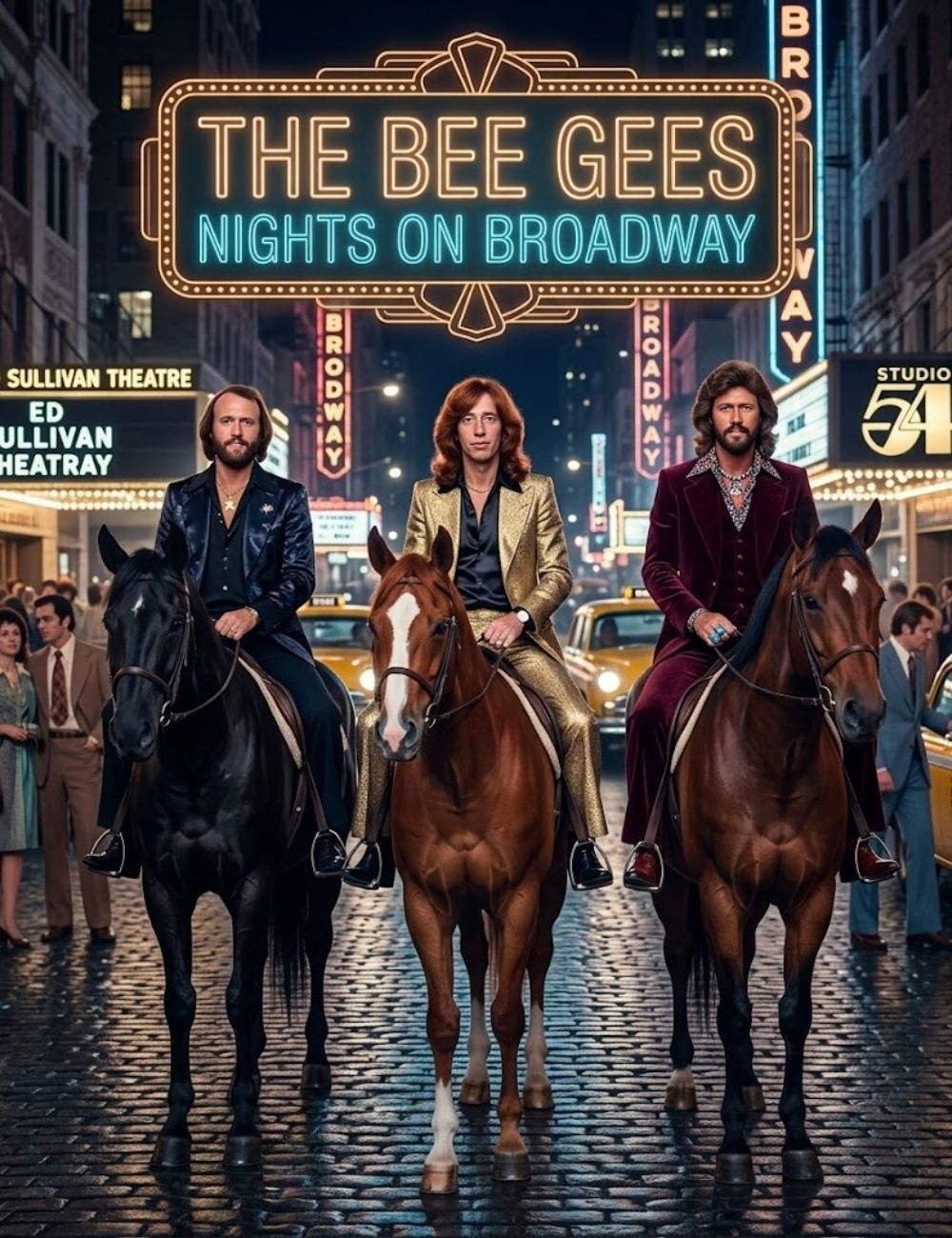
WHEN THE CITY LIGHTS START TO GLOW — THE MYSTERIOUS ENERGY AND MUSICAL REBIRTH OF “NIGHTS ON BROADWAY”
Some songs mark more than a moment in music history—they signal the beginning of transformation. “Nights on Broadway” by the Bee Gees is one of those rare recordings where change can actually be heard unfolding in real time. Beneath its smooth groove and haunting atmosphere lies a turning point in the evolution of one of the most influential vocal groups of the twentieth century, a moment when melody, rhythm, and experimentation came together to create something unforgettable.
By 1975, Barry Gibb, Robin Gibb, and Maurice Gibb had already spent years establishing themselves as extraordinary songwriters and harmony specialists. Their earlier music carried emotional depth and orchestral richness, often shaped around reflective ballads and melodic storytelling. Yet the musical world around them was changing rapidly, and the Bee Gees were ready to move with it. “Nights on Broadway” became the sound of a group stepping confidently into a new era, guided not by trends alone, but by instinct and creative curiosity.
The song begins with an atmosphere that feels instantly cinematic. A deep rhythmic pulse emerges beneath shimmering instrumentation, creating a sense of movement that feels both smooth and slightly mysterious. The bass line glides forward with controlled confidence, while guitars flicker softly like distant neon reflections on wet city streets. From the very first seconds, the music creates a vivid sense of place, capturing the restless energy of urban nights filled with possibility and uncertainty.
When the vocals arrive, the Bee Gees’ unmistakable identity becomes clear. The harmonies are rich yet restrained, layered carefully to preserve the song’s mood. Barry Gibb’s voice carries a quiet intensity, moving through the melody with effortless control. Then, almost unexpectedly, flashes of falsetto begin to appear—brief moments that would later evolve into one of the most recognizable vocal styles in modern music history.
These falsetto moments are among the song’s most fascinating qualities. They do not dominate the recording, but they hint at the direction the Bee Gees were about to take. “Nights on Broadway” captures the exact moment where experimentation becomes discovery, where a new sound begins to emerge naturally from within the music itself.
At the heart of the song lies the atmosphere suggested by its title. Broadway represents more than a physical location; within the song, it becomes a symbol of nighttime energy, ambition, illusion, and emotional tension. The lyrics evoke a world where lights shine brightly while hidden emotions linger beneath the surface, where excitement and loneliness can exist side by side.
Musically, the arrangement reflects this duality perfectly. The groove is smooth and inviting, encouraging movement without becoming overpowering. Yet beneath that rhythm is a subtle emotional tension that gives the song depth. The melody flows with elegance, while the atmosphere carries a faint sense of mystery, creating a listening experience that feels immersive and layered.
The Bee Gees’ harmonies remain one of the recording’s greatest strengths. The voices of Barry, Robin, and Maurice blend together with extraordinary precision, creating warmth and resonance throughout the track. Unlike many vocal groups that rely on sheer volume, the Bee Gees understood the power of subtle vocal interplay. Their harmonies feel almost conversational, weaving naturally around the melody without overwhelming it.
Another remarkable aspect of the song is its balance between sophistication and accessibility. The arrangement is carefully crafted, filled with nuanced musical details, yet it never feels complicated or distant. Instead, it moves with a natural flow that draws listeners in effortlessly. This ability to combine artistic refinement with immediate emotional impact became one of the defining characteristics of the Bee Gees’ greatest work.
Over the decades, “Nights on Broadway” has come to be recognized not only as a memorable song, but as a landmark in the Bee Gees’ artistic journey. It stands at the crossroads between their earlier melodic identity and the rhythm-driven sound that would soon dominate international music. In many ways, it is the bridge between two eras of their career, carrying elements of both while remaining entirely unique.
Listening to the song today still feels remarkably vivid. The groove remains hypnotic, the harmonies still shimmer with warmth, and the atmosphere continues to evoke images of illuminated streets and endless nighttime movement. Few recordings capture mood so completely, transforming sound into something almost visual.
Ultimately, the lasting brilliance of “Nights on Broadway” lies in its sense of discovery. It is the sound of artists pushing beyond familiar boundaries and finding a new voice in the process. Through rhythm, atmosphere, and unforgettable harmony, the Bee Gees created a recording that continues to resonate not only because of its craftsmanship, but because it captures the excitement of transformation itself.
And as the melody drifts through the rhythm once more, the feeling remains unmistakable: some nights never truly end—they continue glowing through memory, music, and the endless echo of a song that changed everything.