
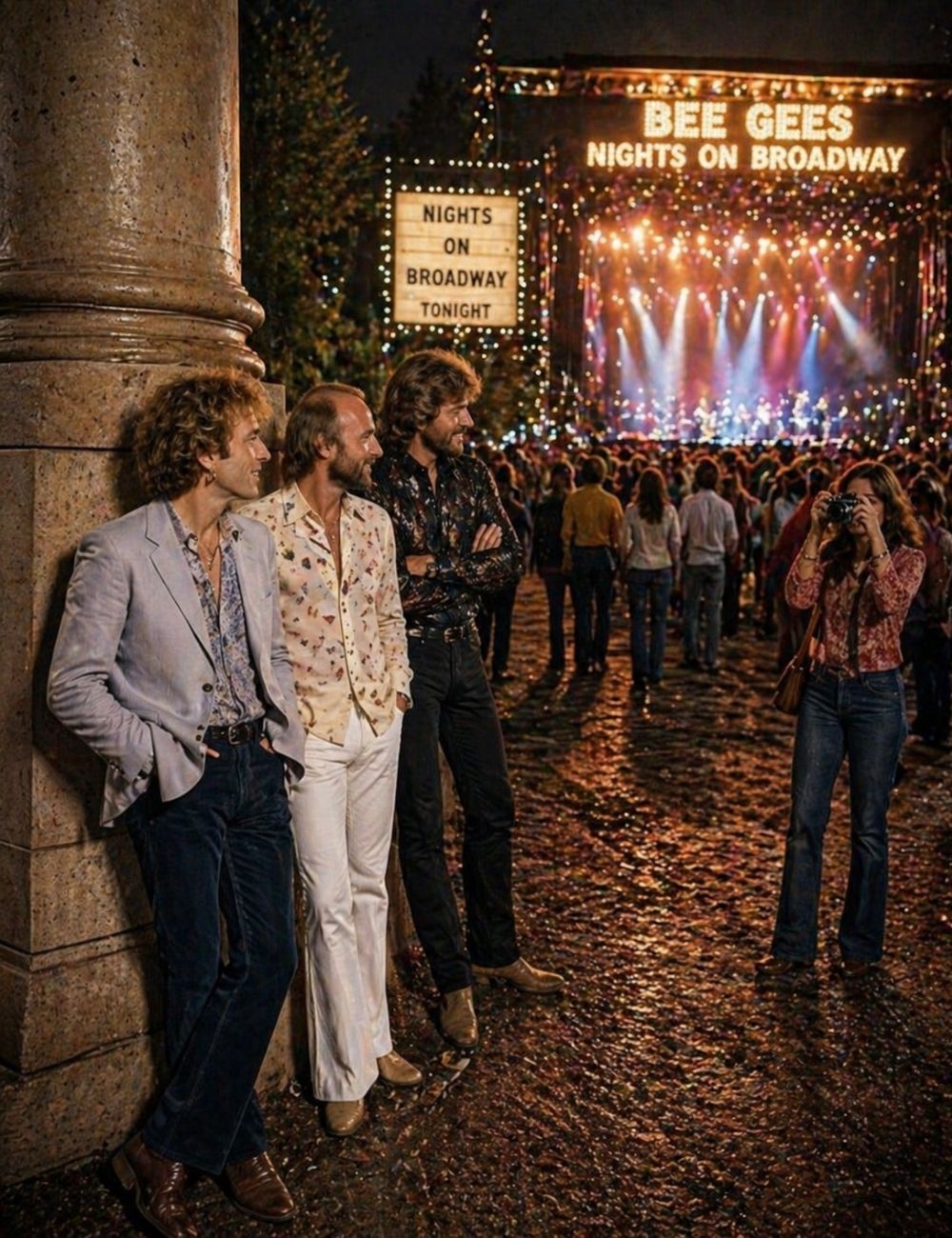
WHEN THE NIGHT COMES ALIVE — THE ELECTRIC SOUL AND MUSICAL TURNING POINT OF “NIGHTS ON BROADWAY”
Every legendary musical career has moments that quietly shift the direction of everything that follows. These are the recordings where experimentation meets instinct, where artists discover a new dimension of their sound without fully realizing how influential it will become. “Nights on Broadway,” released in 1975 by the Bee Gees, represents one of those pivotal moments. The song did not merely add another success to their catalogue—it revealed a bold transformation in the group’s musical identity, introducing elements that would soon redefine their place in popular music.
By the mid-1970s, Barry Gibb, Robin Gibb, and Maurice Gibb had already built an impressive reputation through melodic ballads and richly layered harmonies. Their earlier work carried strong traces of orchestral pop and reflective storytelling. Yet the musical world around them was evolving rapidly, and the Bee Gees were ready to explore new possibilities. “Nights on Broadway” became one of the first clear signals that their sound was entering a new era—one defined by rhythm, groove, and an emerging sense of musical confidence.
The opening of the song immediately reveals this transformation. A tight rhythmic foundation begins to pulse beneath the melody, driven by a bass line that moves with quiet determination. Guitar accents shimmer above the rhythm, while subtle keyboard textures create an atmosphere that feels both urban and mysterious. The arrangement suggests the energy of a city after sunset, where lights glow against the darkness and music drifts through the air.
When the vocals enter, the familiar Bee Gees magic becomes unmistakable. The brothers’ harmonies blend with remarkable precision, creating a sound that feels both smooth and expressive. Yet there is also something new in the vocal approach. Barry Gibb begins to explore the falsetto style that would later become one of the most recognizable voices in modern music. In this song, that vocal tone appears in brief flashes—moments that hint at the direction the group would soon take.
The title itself evokes a vivid setting. Broadway has long been associated with bright lights, late-night performances, and the restless energy of a city that never truly sleeps. Within the song, this setting becomes more symbolic than literal. The “nights on Broadway” represent the mysterious hours when creativity, ambition, and imagination seem to awaken, when the world feels both thrilling and unpredictable.
Musically, the song moves with a sense of controlled tension. The rhythm is steady yet flexible, allowing the melody to glide across it with ease. Guitar lines flicker like reflections of neon lights, while the bass anchors the composition with confident precision. The entire arrangement feels alive with movement, capturing the sensation of walking through a vibrant city street long after the sun has disappeared.
One of the most fascinating aspects of the recording is its balance between restraint and intensity. The verses unfold with quiet sophistication, allowing the melody to develop gradually. Then, as the song progresses, the chorus expands with greater energy and vocal power. This dynamic structure creates a feeling of anticipation, as though the music itself is exploring the shifting moods of nighttime.
The Bee Gees’ harmonies remain at the center of the experience. Their voices move together with almost effortless precision, forming layers of sound that give the melody both warmth and depth. Unlike many vocal groups, their harmonies never feel crowded or excessive. Instead, each voice contributes to a unified expression that feels natural and fluid.
“Nights on Broadway” also marks an important step in the Bee Gees’ evolution toward the rhythmic sound that would soon dominate the late 1970s. While the song is not yet fully immersed in the dance-oriented style that later defined their work, it clearly points in that direction. The groove is stronger, the rhythm more central, and the overall atmosphere more modern than much of their earlier music.
For listeners today, the song offers a fascinating glimpse into a moment of artistic discovery. It captures the Bee Gees at a crossroads—still connected to their earlier melodic sensibilities yet beginning to embrace a new musical language. This blend of familiarity and innovation gives the recording a special charm. It feels both reflective of the past and quietly excited about the future.
Over the years, “Nights on Broadway” has continued to resonate with audiences who appreciate the Bee Gees’ remarkable journey through changing musical landscapes. The song reminds listeners that great artists are rarely static. They evolve, experiment, and adapt, guided by instinct and curiosity.
Ultimately, the enduring appeal of “Nights on Broadway” lies in its atmosphere. Through elegant melody, rhythmic confidence, and luminous harmonies, the Bee Gees created a piece of music that captures the mysterious beauty of nighttime creativity. It is a song that feels both grounded and dreamlike—like the glow of city lights reflected in the quiet hours after dark.
And as the music unfolds, one can almost imagine those endless streets illuminated by neon and possibility, where melodies drift through the air and the night itself seems to pulse with rhythm, imagination, and the promise of something extraordinary.