
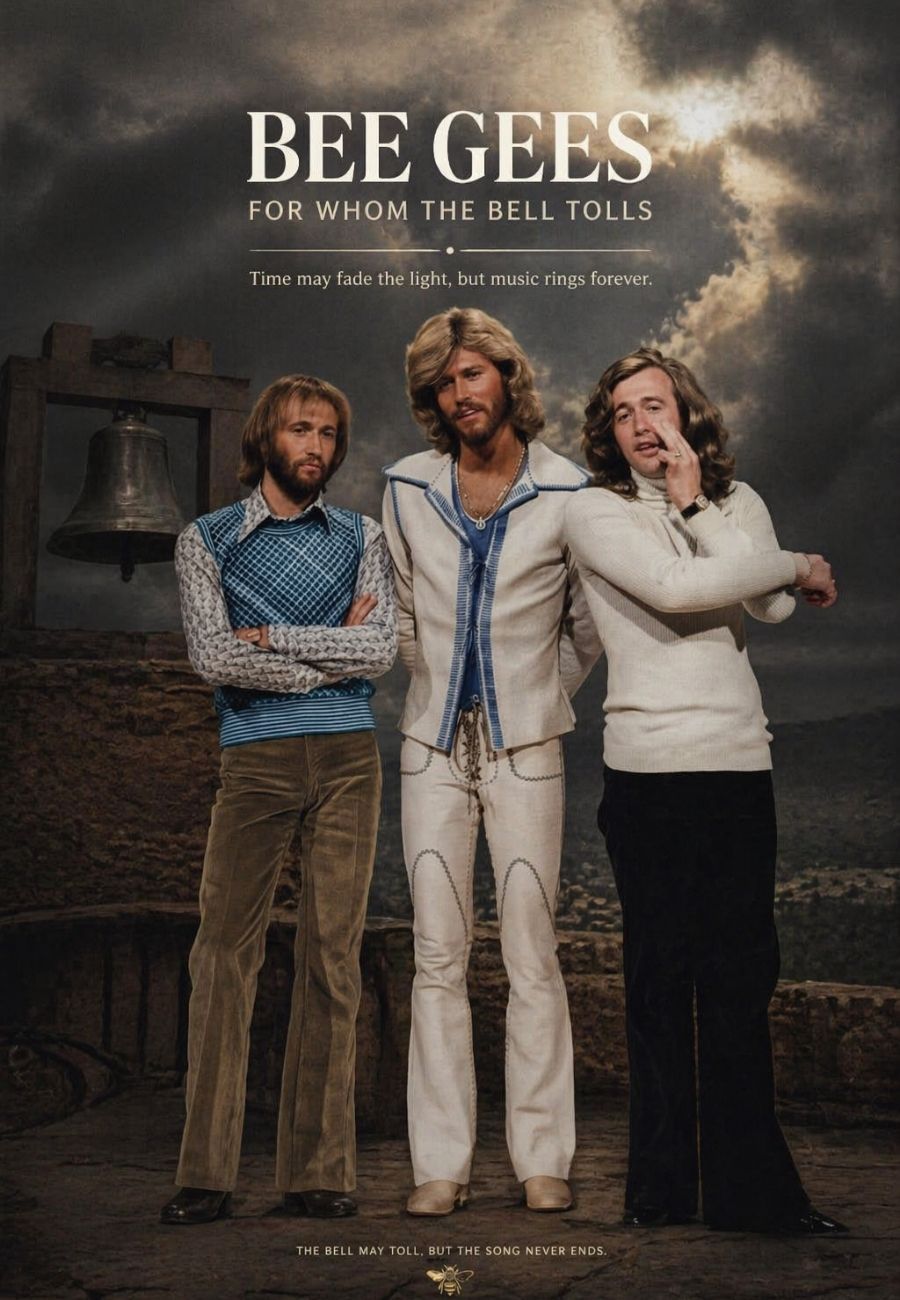
“For Whom the Bell Tolls” — The Bee Gees’ Poignant Meditation on Love, Time, and Quiet Goodbyes
Among the most reflective compositions recorded by the Bee Gees, the emotional ballad For Whom the Bell Tolls stands as one of the group’s most thoughtful works from the later stages of their career. Written by Barry Gibb, Robin Gibb, and Maurice Gibb, the song reflects the maturity of artists who had already spent decades translating human emotion into music.
Released in 1993 as part of the album Size Isn’t Everything, the song arrived during a time when the Bee Gees were exploring deeper and more introspective themes. After years of global fame, cultural influence, and personal experiences, their songwriting had evolved into something richer and more contemplative.
The song opens with a calm and atmospheric arrangement. Soft keyboards and restrained instrumentation create a gentle musical landscape, inviting listeners into a quiet emotional space. Rather than building dramatic intensity immediately, the composition unfolds gradually, allowing the mood to develop with subtle elegance.
Barry Gibb’s lead vocal guides the listener through the story with a tone that feels both reflective and sincere. His voice carries the emotional weight of someone looking back on a relationship that once held great promise but has slowly drifted away. The performance is not dramatic or forceful; instead, it conveys emotion through nuance and careful phrasing.
As the melody progresses, the harmonies of Robin and Maurice enter with remarkable delicacy. Their voices blend with Barry’s in the distinctive harmony style that has always defined the Bee Gees’ sound. These harmonies deepen the emotional atmosphere without disturbing the calm flow of the song.
The title itself draws inspiration from a phrase that suggests the passing of something significant. Within the context of the lyrics, the ringing bell becomes a metaphor for the moment when a relationship quietly reaches its end. There is no dramatic conflict in the story—only the slow realization that time has changed something once cherished.
The lyrics reflect the confusion and sadness that can arise when affection fades despite the memories that remain. The narrator wonders how something that once felt so powerful could gradually disappear. Yet instead of anger or bitterness, the song expresses acceptance and quiet reflection.
This emotional restraint is one of the song’s most powerful qualities. It captures the experience of looking back on a relationship with a mixture of nostalgia and understanding. Many listeners recognize this feeling—the moment when memories remain vivid even though life has moved forward in new directions.
When released as a single, the song achieved notable success on the UK Singles Chart, becoming one of the Bee Gees’ most successful recordings of the 1990s. Its popularity demonstrated that the group’s songwriting remained deeply relevant even after decades in the music industry.
Over time, “For Whom the Bell Tolls” has become one of the most admired songs among fans who appreciate the Bee Gees’ more reflective work. While their energetic hits often dominate popular memory, songs like this reveal the emotional depth that has always existed within their music.
Even today, when the song begins, its quiet melody invites listeners into a moment of reflection.
And within its thoughtful message lies a universal truth:
sometimes the most meaningful endings are not marked by dramatic words, but by the quiet understanding that time has gently closed a chapter of the heart.