
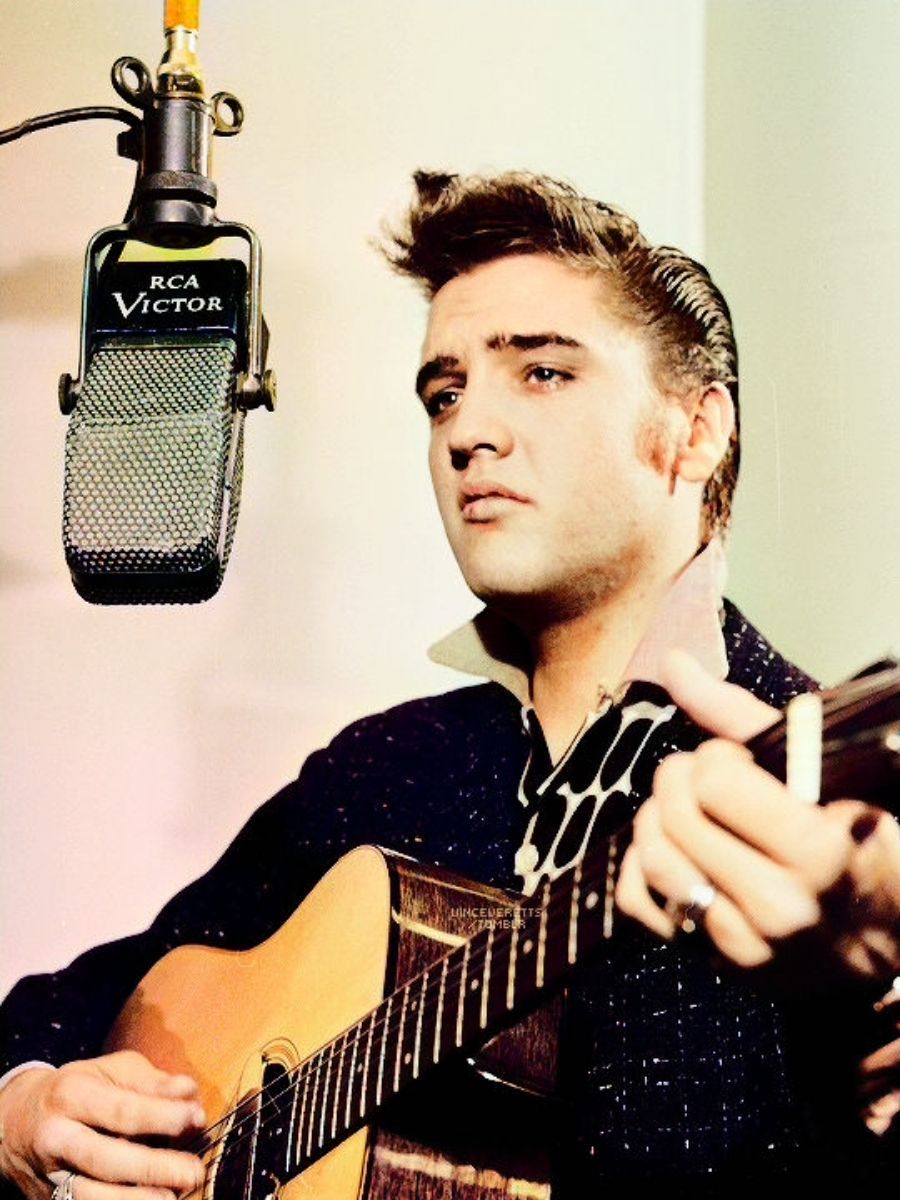
A QUIET AUGUST AFTERNOON IN 1953 — WHEN ELVIS PRESLEY WALKED INTO SUN RECORDS TO RECORD “MY HAPPINESS” AND “THAT’S WHEN YOUR HEARTACHES BEGIN,” UNAWARE HE WAS ABOUT TO CHANGE MUSIC FOREVER
It was an ordinary August afternoon in 1953, warm and unremarkable, the kind of day that rarely announces its importance. There were no crowds outside, no reporters waiting, no sense that history was about to move. And yet, on that quiet day, Elvis Presley walked through the door of Sun Records and unknowingly stepped into the future of music.
Elvis was just a teenager then. Shy, soft-spoken, and dressed simply, he did not arrive with dreams of fame or revolution. He came for a modest reason — to record a song as a personal keepsake. A small gift, meant not for the world, but for someone he loved. There was nothing grand about his intention, and that is precisely what makes the moment so powerful.
Inside the studio, the atmosphere was calm and functional. No dramatic lighting. No grand equipment by today’s standards. Just a microphone, a reel-to-reel machine, and a young man trying to steady his nerves. Elvis chose two songs that spoke quietly rather than boldly: My Happiness and That’s When Your Heartaches Begin. They were gentle ballads, filled with longing, heartbreak, and emotional honesty.
When Elvis began to sing, there was no attempt to impress. His voice did not push or strain. It trembled slightly, not from weakness, but from sincerity. Even then, something unusual was present — a natural sense of phrasing, a feeling that the words mattered to him. He sang as if the room had disappeared, as if only the emotion remained.
Those recordings were not meant to launch a career. They were not intended for radio. They were simply expressions of feeling, captured on tape. And yet, within those fragile takes lived the earliest trace of a voice that would soon reshape popular music. Not loud. Not polished. Just real.
What Elvis could not have known that afternoon was how deeply his instincts would resonate with the world. How his natural blending of country, gospel, blues, and emotion would unlock something audiences didn’t yet realize they were waiting for. In that small studio, without spectacle or awareness, a new sound quietly introduced itself.
Sun Records would later become synonymous with transformation — a place where raw talent was not smoothed away, but allowed to exist honestly. And Elvis Presley, who walked in as an unknown teenager, would soon return as something entirely different. But on that August afternoon, none of that had happened yet.
There was no crown.
No title.
No “King.”
There was only a young man, standing at a microphone, singing from a place of feeling rather than ambition. History did not arrive with thunder that day. It arrived softly, almost unnoticed, wrapped in two simple songs and a voice still finding itself.
Looking back now, it is impossible not to feel the weight of that moment. Because sometimes, the most important changes do not announce themselves. They happen quietly — in small rooms, on ordinary days — when someone follows a feeling without knowing where it will lead.
On that afternoon in 1953, Elvis Presley didn’t know he was changing music forever.
But music knew.